Emission and immunity testing for electronics, appliances, lighting, EV, telecom and industrial equipment. We work out which standard genuinely applies to your product and your market, match it to a lab with that scope, and get the report written so the people who have to accept it, will.
EMI · EMC · CISPR & IEC 61000
EMC (electromagnetic compatibility) is emission and immunity testing — does your product interfere with others, and can it survive interference itself. Your BIS certificate almost never covers this; you need the right CISPR / IEC 61000 standard and a lab with that scope.
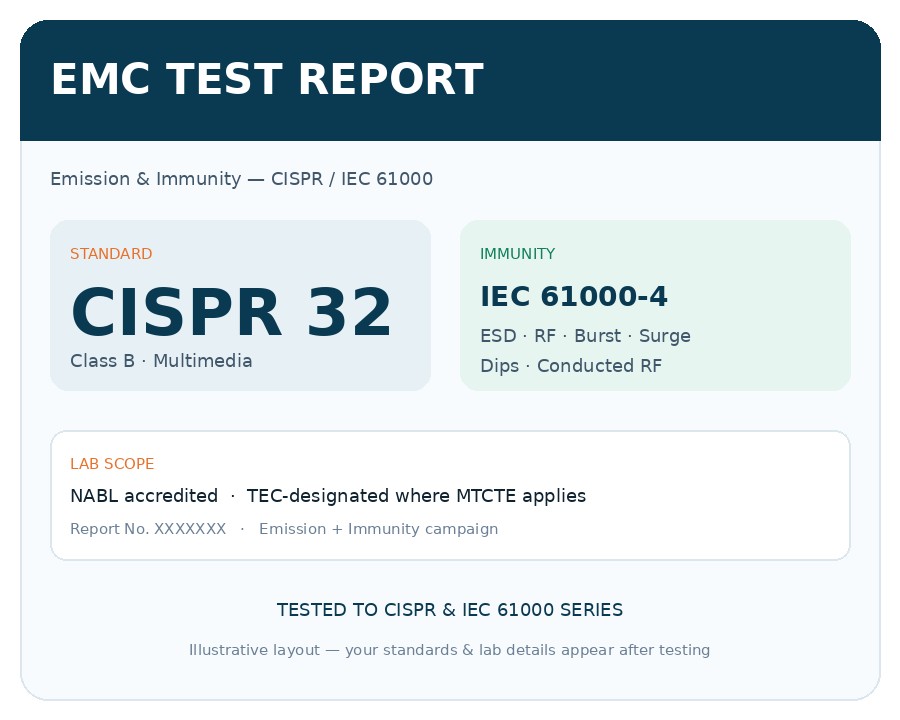
What the campaign covers
Pick the standards your market and product family actually require, then book a lab that can run that full campaign — not a partial scan.
Radiated & conducted — Class A / B and product-family limits
ESD, RF, burst, surge, dips and related immunity methods
Find layout / filter issues before the formal booking
Map the obligation, then book a lab with that exact scope
Free tool · no sign-up
Choosing the standard is the hard part of EMC, and it is where most money gets wasted. Pick your product family and where you're selling — you'll see the emission and immunity standards that normally apply, the tests that will actually run, and which approval it feeds.
A guide, not a test plan. The applicable standard depends on the exact product, its ports, its power rating and sometimes its intended environment — we confirm all of it in writing before anything is booked.
Get my test plan →The call we have most often
BIS registration under the Compulsory Registration Scheme is granted against a safety standard — IS 13252, IS 616, IS 16046 and the rest are safety standards. Passing one says nothing about what your product radiates, or what it survives when something else radiates at it.
So where does the EMC obligation come from in India? Not from one law. It arrives through whichever route your product takes — TEC MTCTE if it is telecom equipment, WPC ETA if it has a radio in it, AIS if it goes on a vehicle, and otherwise through a tender clause, a buyer's purchase condition, or the export market you are shipping to. Finding that out after you have shipped is expensive. Finding it out before you finalise the board is not.
Two halves, and you need both
Emission is what your product puts out. Immunity is what it has to survive. A report covering only one of them is half a report — and buyers who read carefully will say so.
Four things people get wrong
An IP failure is a gasket. An EMC failure is usually a board layout, a missing filter, a cable that acts as an antenna or a shield that was value-engineered out. Those are hardware changes. Booking a formal slot as the first EMC event you have ever had is how a two-week test becomes a six-month redesign.
Class A and Class B are different limit lines, roughly 10 dB apart. CISPR 11 Group 1 and Group 2 are different equipment entirely. Declare the convenient one and you have a report that passes against a limit your product does not have to meet — which a competent reviewer will spot and reject.
IEC 61000-6-1 to -6-4 are the fallback for products with no standard of their own. If a product-family standard does exist — CISPR 32, CISPR 14, CISPR 15 — it takes precedence, and a generic report against it can be refused outright. This is a common and entirely avoidable waste.
A CISPR 32 report is not automatically an FCC report — the limits and the measurement methods differ. And for TEC MTCTE the laboratory itself is prescribed, so even a flawless report from elsewhere will not be accepted. Plan the markets together and one campaign can usually cover most of them.
The part most consultants skip
A pre-compliance scan is a shorter, cheaper session that tells you where you stand before you commit to a formal booking. It is not accredited, it does not get declared anywhere, and that is exactly the point — nothing has to be reported if it fails.
We suggest it for anything with a switching supply, a fast processor, a motor drive or a radio on board. If the scan is clean you go to the formal test with confidence. If it is not, you have found out at the stage where a ferrite, a filter or a ground-plane change still costs almost nothing.
A board respin — new layout, new prototypes, new assembly run, and every downstream date moves with it.
A second chamber booking at full price, in a queue you have to rejoin from the back.
An enclosure change where shielding or a gasket has to be added to a housing whose tool is already cut.
A shipment held or a tender lost while the corrected report is produced.
Typical outcomes we see, not a prediction for your product. The point is simply that all four are cheaper to avoid than to fix.
Where the demand comes from
The answer decides which laboratory can do the work — so it is the first thing we establish, before anything else.
EMC is one of the Essential Requirements under Mandatory Testing and Certification of Telecom Equipment, and testing has to be done at an Indian laboratory designated by TEC for that parameter. This is the one case where the lab is not a choice — a report from any other laboratory, however good, will not be accepted.
Wireless products face two separate campaigns: the radio parameters for the Equipment Type Approval, and the EMC work alongside it under the EN 301 489 family. Two reports, two budgets. Planning them together saves a sample shipment and a queue.
Tenders for lighting, metering, railway and defence supply name the standard by number and often name the accreditation the report must carry. We read the clause before quoting, because "CISPR 15" and "CISPR 15 tested at an NABL laboratory with the report in the bidder's name" are different requirements.
Most products self-declare, with no notified body involved. That does not mean self-testing — if market surveillance ever asks for the technical file, an accredited report against the correct harmonised standard is what holds the declaration up.
Buyers ask for the regime of their own market, and those regimes do not map onto each other cleanly. We establish exactly what they will accept, in writing, before the sample ships anywhere.
The cheapest EMC work is the work done while the layout can still change. Pre-compliance at prototype stage costs a fraction of a failed formal test plus a respin, and nothing about it has to be declared.
How it works
Product family, class, group, ports, operating environment and every market you sell into — pinned down in writing. Everything downstream depends on getting this right, and it is where most of the value sits.
Which tests, at which levels, with which functions running and what counts as a pass. Agreed with you before the lab is approached, so nobody is deciding it at the chamber door.
A shorter scan to find the problem while a fix is still cheap. We tell you honestly when your product does not need it and you should go straight to the formal test.
Scope, accreditation, chamber size and availability checked against your plan. Where your route needs a TEC-designated or FCC-recognised laboratory, that constraint is where we start, not where we discover a problem.
We stay on the file through the slot, then check the report says what your buyer or your filing needs it to say — and help you build the declaration or the technical file around it.
We work through the plots with you — which frequency, which port, which harmonic — and get you a diagnosis rather than a certificate of failure. Then we agree the fix and requote honestly, including whether a partial retest is enough.
What we need from you
The last one matters more than people expect. Telling us about the European order after the India testing is booked usually means paying for a second campaign that could have been one.
Send what you have. Nothing needs to be final to start the conversation, and an early call is often the cheapest part of the whole exercise.
Client feedback
We assumed our BIS registration covered EMC. It didn't. Finding that out on a first call rather than from a customs hold was worth the whole fee.
The pre-compliance scan caught a radiated emission problem at 240 MHz. We added a ferrite and a ground stitch. The formal test passed first time.
They planned India and the EU as one campaign instead of two. We'd been quoted for two by everyone else and never questioned it.
Names shortened at our clients' request. References available on request for serious enquiries.
FAQ
There is no single EMC law covering every product. The obligation arrives through whichever scheme your product falls under.
Telecom equipment picks it up through TEC MTCTE, where EMC is one of the Essential Requirements and testing has to happen at a TEC-designated Indian laboratory. Anything with a radio goes through WPC ETA for the radio side, with EMC handled alongside it. Automotive components sit under the AIS framework. For everything else it usually comes from a tender clause, a buyer's purchase condition, or the export market you are shipping into.
Which of those applies to you also decides which laboratory can do the work, so it is the first thing we settle.
For most products under the Compulsory Registration Scheme, no.
CRS registration is granted against a safety standard — IS 13252, IS 616, IS 16046 and the others in the list are safety standards. They deal with shock, fire and mechanical hazards. They do not test what your product radiates or what it withstands.
This is the single commonest misunderstanding we encounter, and it usually surfaces when an export buyer or a tender asks for something the BIS certificate cannot supply.
EMI is the interference itself. EMC is the property of coexisting with it.
In practice "EMI testing" usually means the emission half — measuring what your product radiates and conducts out. EMC covers that plus the immunity half, which is what happens to your product when something else radiates at it. A complete campaign needs both, and a report with only emission results is half a report.
Plan for one to three weeks in the lab once samples arrive, depending on how many tests the standard calls for and how long your product needs in the chamber.
The calendar is usually set by chamber availability rather than by the testing itself — good chambers run full. Add the sample logistics and the report drafting and a straightforward campaign is typically three to five weeks end to end. We quote the realistic date rather than the optimistic one, and tell you when a slot is tight.
There are two numbers and we always show them separately.
The lab charge, which depends on the standard, the number of tests in the plan and your chamber time. A simple Class B emission-only scan and a full medical campaign under IEC 60601-1-2 are different orders of magnitude. And our fee, for settling the standard, writing the test plan and performance criteria, matching the lab and managing the file through to the report.
You see the lab's figure before we book, not after. If a retest becomes necessary we requote it honestly rather than treating it as included.
First, get the plot and the frequency, because the frequency usually tells you the source.
Common culprits are switching-supply harmonics, a clock or its harmonics coupling onto a cable, a cable acting as an antenna because its shield is not properly bonded, and a shield or gasket that was removed to save cost. The fixes range from a ferrite or a filter component up to a layout change.
We go through the plots with you and get to a diagnosis rather than a guess, then agree what gets changed and whether a partial retest will cover it.
Often, if it is planned that way from the start.
CISPR-based requirements underpin the EU, the UK and much of Asia, so one properly scoped campaign can serve all three. FCC needs its own measurement set but can usually run in the same lab visit. The exceptions are the India-specific routes — TEC and WPC — which prescribe where the testing happens and have to be planned around.
What does not work is testing for one market and hoping the report travels. Tell us every destination at the start, including the uncertain ones.
No, and we would be careful of anyone who claims to do both.
Testing is done by accredited laboratories with the right chambers and scope. Our job is to determine the correct standard and class, write the test plan and performance criteria, find the laboratory that can actually run it — including TEC designation where your route requires it — prepare the sample and paperwork so the first attempt is the one that passes, and make sure the report you receive says what your buyer or your filing needs it to say.
Send the model, its ports and every market you're selling into. You'll get a straight answer on which standard applies, what the test plan looks like, which laboratory can run it and what it costs — lab charge and our fee shown separately.

