The Gulf Conformity Mark for low voltage equipment, appliances and toys across all six GCC states. We establish whether it actually applies to your product, run the right route, build the Arabic file properly — and tell you what Saudi Arabia or the UAE will still want on top of it.
Gulf Conformity Mark · GSO
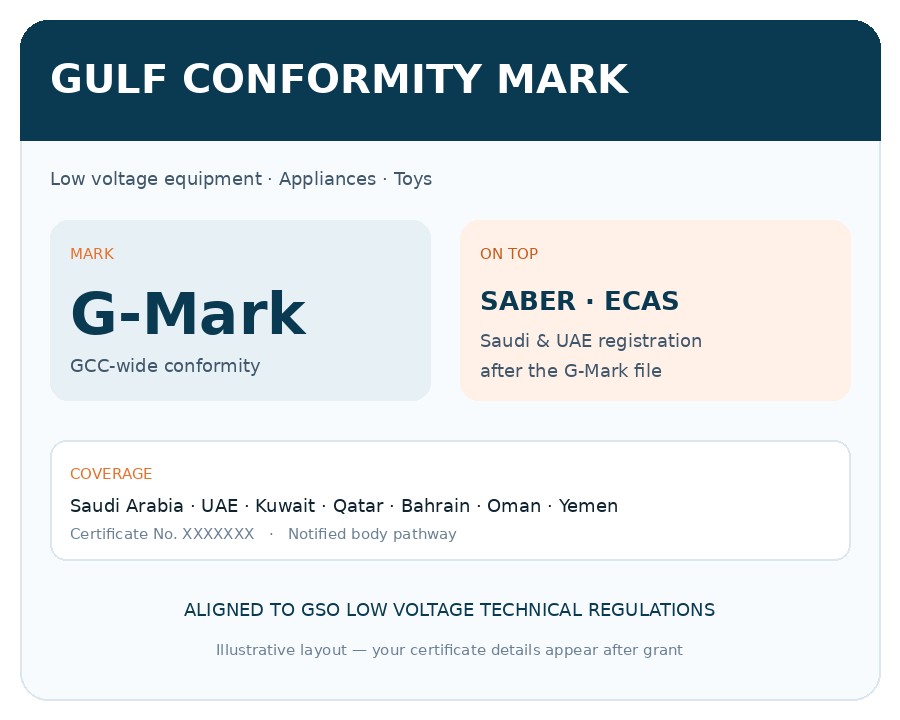
G-Mark is the Gulf Conformity Mark for low voltage equipment, appliances and toys sold across GCC markets. It is the shared conformity file — Saudi SABER and UAE ECAS are usually still needed on top before goods clear those countries.
Gulf markets
Start with the shared G-Mark file, then add the Saudi and UAE registrations each destination still asks for before clearance.
Gulf Conformity Mark for regulated low-voltage products
Saudi product registration / shipment approval on top of G-Mark
UAE conformity registration after the shared Gulf file
Map which Gulf states need what before samples and filing
Free tool · no sign-up
G-Mark is the Gulf-wide layer. Every member state then runs its own system on top of it, and that is the part exporters find out about at the port. Pick your product and your destination — you'll see which applies, which route you go down, and what the country wants in addition.
A guide, not a determination. Scope is decided by the HS code and the product's exact specification, and Gulf technical regulations are amended periodically — we confirm your position in writing before anything is filed or tested.
Check my product →Before you buy a certificate
This is the call we take most often, usually from someone whose container is already at Jeddah or Dammam. They hold a valid G-Mark certificate. They assumed it was the key to the Gulf. It is not.
G-Mark is the Gulf-wide technical layer — it says your product meets the GSO technical regulation for its category. Each member state then runs its own national conformity system on top, and that is the one customs actually checks. Saudi Arabia wants a PCoC for the product and an SCoC for the shipment through the SABER platform. The UAE wants ECAS registration for regulated categories. Neither is replaced by your G-Mark certificate, and neither can be arranged quickly once the goods have sailed.
The basics, stated plainly
The GCC Standardization Organization, GSO. It publishes the Gulf technical regulations and approves the Notified Bodies that assess products against them.
Saudi Arabia, the UAE, Kuwait, Qatar, Bahrain and Oman, plus Yemen. One assessment, one certificate, seven markets — which is the real saving in it.
The tracking symbol — the G-Mark itself, the four-digit Notified Body number and a QR code so customs can verify the certificate. Minimum 5 mm tall, permanently affixed.
Low voltage electrical equipment and appliances under BD-142004-01, children's toys under BD-131704-01, and water-consuming products under the newer conservation regulation.
Some products go by manufacturer declaration with factory control and line testing. Others need a Notified Body and a Gulf Type Examination certificate. The product list decides.
Certificates are typically issued for a defined term and renewed. The declaration of conformity itself has to be kept for at least ten years from the date of manufacture.
Four things exporters get wrong
Cosmetics, automotive parts, medical devices and machinery above the low voltage range are all routinely certified to G-Mark by exporters who did not need it. The scope is set by the technical regulation and the HS code, not by whether a certification body is willing to sell you one.
The G-Mark layer is genuinely Gulf-wide and that is its value. The national layer is not. Saudi Arabia's SABER, with a product certificate and a separate shipment certificate, is a different exercise from the UAE's ECAS, and neither is covered by the other.
The declaration of conformity, the safety manual and the labelling are required in Arabic. This is a compliance requirement with technical content, not a translation job — and a manual run through machine translation the week before shipping is how files come back for correction.
For low voltage products, an IECEE CB certificate and report carries a presumption of conformity for much of the safety assessment. If you already hold one for CE or another market, a large part of the work is done — and paying to repeat it is a pure loss.
How the Gulf actually works
Get this picture right and the rest of the project plans itself.
The Gulf technical regulation for your product category. Testing, the technical file, the risk analysis, the Arabic declaration, and a Notified Body assessment where the route requires one. This is the part that genuinely is Gulf-wide — you do it once, and it does not need repeating per country.
A Product Certificate of Conformity registered against your Saudi customs tariff code and valid for one year, then a Shipment Certificate of Conformity for each consignment, which can only be issued if the PCoC is live. No SCoC, no clearance. This is the single most common reason Indian exporters get stuck at a Saudi port.
The Emirates Conformity Assessment Scheme is mandatory for regulated product categories and is administered through the Ministry of Industry and Advanced Technology. The Emirates Quality Mark is voluntary and assesses your factory as well as your product — worth having when a retailer or a government buyer asks for it, and not otherwise.
Lighter than Saudi Arabia, but not nothing. Each runs its own import conformity documentation, Arabic labelling requirements and attestation rules, and public-sector buyers frequently add conditions of their own in the purchase order. We confirm the current position per destination rather than working from last year's experience.
Companies that treat every country as a fresh project pay for the same testing three or four times and still miss a deadline somewhere. One set of test reports and one Arabic documentation pack can feed the whole Gulf — but only if it is built that way from the first day.
How it works
Which technical regulation applies, whether your product is even in scope, and which route it goes down. Settled against the HS code and the product specification, in writing, before anything is quoted.
CB certificate, CE file, existing test reports — we work out what can be reused before quoting any testing. This step regularly takes a third off the bill.
Safety and EMC testing where needed, risk analysis, bill of materials, drawings and rating label artwork, assembled into a file that stands up to review rather than one that merely contains the right documents.
Declaration of conformity, safety manual and labelling prepared in Arabic, then the Notified Body submission where the route calls for one, through to the certificate and the tracking symbol artwork.
SABER registration and the PCoC for Saudi Arabia, ECAS for the UAE, import conformity for the rest — set up before your first consignment sails, not after it has arrived.
For Saudi Arabia the SCoC is raised per consignment against the live PCoC. We can run that for you shipment by shipment, or set your team up to do it — whichever you would rather. Renewals are tracked either way.
What we need from you
The HS code does more work here than anything else. Scope under the Gulf technical regulations and registration in SABER are both driven by it, so getting it right at the start prevents most of what goes wrong later.
Send what you have. If you are not sure whether you need G-Mark at all, that is a good reason to call rather than a reason to wait.
Why it matters
In most export markets a documentation problem becomes a letter. In the Gulf it becomes a container sitting at a terminal accruing charges while somebody tries to obtain retrospectively what should have existed before departure.
That is why the sequencing work at the start is worth more than anything else we do on these projects.
A consignment held because a shipment certificate could not be raised — demurrage and storage from day one, with no way to speed it up.
A certificate against the wrong tariff code, which reads as valid until the moment customs matches it to the declaration and finds it does not fit.
An Arabic file rejected, sending the whole submission back while the shipment date stands.
A mark applied where it does not belong — worse than no mark, because it is a claim you cannot support.
General guidance on Gulf conformity practice. Requirements differ by product, tariff code and destination, and are amended periodically — we confirm your position before anything is filed.
Client feedback
We had the G-Mark and thought Saudi was covered. They explained the PCoC and SCoC on the first call and got it set up before our container left Nhava Sheva.
Our existing CB report covered most of what was needed. Nobody else had asked whether we had one — they just quoted for full testing.
They told us our product wasn't in the G-Mark scope and pointed us at what actually applied. That honesty cost them a sale and won them our account.
Names shortened at our clients' request. References available on request for serious enquiries.
FAQ
The Gulf Conformity Mark is the conformity marking of the GCC Standardization Organization. It shows that a product meets the applicable Gulf technical regulation for its category.
It covers low voltage electrical equipment and appliances under BD-142004-01, children's toys under BD-131704-01, and more recently water-consuming products. The mark is recognised across Saudi Arabia, the UAE, Kuwait, Qatar, Bahrain, Oman and Yemen, which is where its value lies — one assessment rather than seven.
No, and this is the most expensive misunderstanding in Gulf trade.
Saudi Arabia operates the SABER platform under its SALEEM programme. Regulated products need a Product Certificate of Conformity, registered against the Saudi customs tariff code and valid for one year, and then a Shipment Certificate of Conformity for each individual consignment. The SCoC can only be issued where a live PCoC already exists, and without the SCoC the goods do not clear.
Your G-Mark certificate supports the conformity assessment. It does not substitute for either of those.
They serve different purposes and neither replaces the other.
ECAS is the UAE's own mandatory scheme for regulated product categories and is what gets your product legally onto the UAE market. G-Mark is the Gulf-wide layer, which matters if you are selling across the region rather than into the UAE alone.
If the UAE is your only Gulf market, ECAS may be all you need. If you are also shipping to Saudi Arabia, Kuwait or the others, doing the G-Mark work once is usually the cheaper path.
Scope is set by the technical regulation and determined in practice by the HS code, not by the product description.
The low voltage regulation covers equipment with a nominal supply between 50 and 1000 V AC or 75 and 1500 V DC — household appliances, kitchen equipment, air conditioning, lighting, power tools, chargers and adaptors. Specifically excluded are medical and radiology equipment, lift components, electricity meters, equipment for ships, aircraft and railways, and equipment for explosive atmospheres.
Cosmetics, food, vehicles and tyres sit outside the scheme entirely and take different routes.
It depends on which list your product falls into, and that is not a choice you get to make.
Some products go by manufacturer declaration, supported by factory production control and production line testing. Others require a Notified Body to carry out a technical design examination and issue a Gulf Type Examination certificate before the mark can be applied.
Toys are assessed particularly carefully because of the mandatory risk analysis. We establish which route applies to your product before quoting, because it is the single biggest factor in the cost.
For a straightforward low voltage product with existing test reports, plan for a few weeks. Where full testing is needed, add the lab queue and the sample logistics.
Two things stretch the timeline more than people expect: preparing the Arabic documentation properly, and the national registration afterwards. If you have a shipment date committed, tell us on the first call and we will work backwards from it and say plainly whether it is achievable.
For low voltage products, considerably.
An IECEE CB certificate and report carries a presumption of conformity for much of the safety assessment under the Gulf low voltage regulation. If you already hold one — commonly you will, if you have done CE marking or sold into other CB-scheme markets — a large part of the testing work is already complete.
Send it with your first enquiry. It is the quickest way to reduce the quote.
What goes on the product is the tracking symbol, not just the letter mark.
It carries the G-Mark itself, the four-digit identification number of the Notified Body where one was involved, and a QR code that lets customs officers and buyers verify the certificate is live. It must be at least 5 mm high, permanently affixed, and clearly visible on the product, its label or its packaging.
We supply the artwork at the correct proportions so it does not get redrawn incorrectly on your packaging.
Send the model, the HS code and the Gulf markets you're selling into. You'll get a straight answer on whether G-Mark applies, which route it takes, what the destination country wants on top — and what it costs, with lab and Notified Body charges shown separately from our fee.

