ICDR registration is mandatory for importers and manufacturers alike — if you bring devices with IMEIs into India, or build them here and sell them, you have to register. Separately, if you want your own IMEI numbers under your own brand, that means GSMA brand registration and TAC allocation. We consult on both.
IMEI · ICDR & TAC
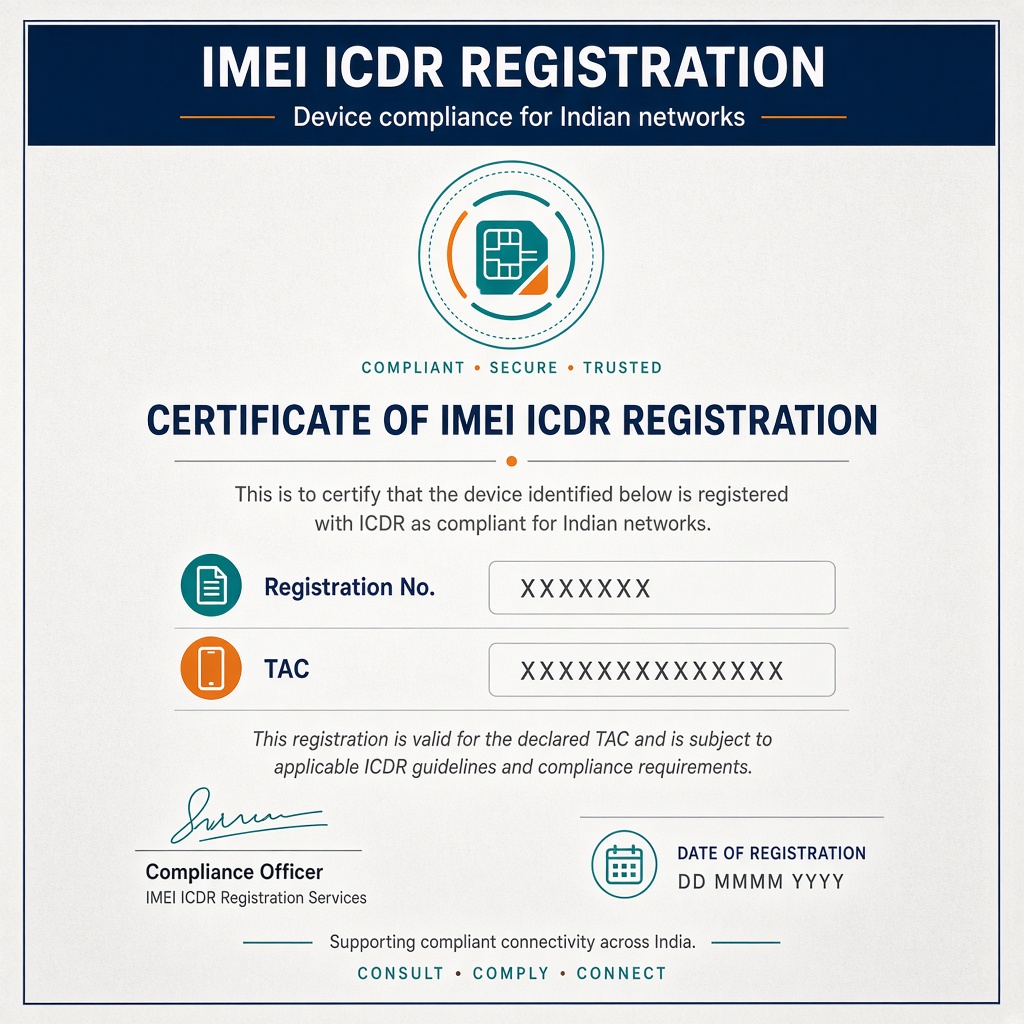
ICDR registration is mandatory to import or sell devices with IMEI numbers on Indian networks. Separately, brand registration and TAC allocation with GSMA create the IMEI numbers themselves — most people need clarity on which of the two applies.
Two services
Almost everyone says “IMEI certification”. It means two different things depending on whether you already have IMEIs or need new ones.
Import or sell IMEI devices on Indian networks
GSMA brand registration and new IMEI ranges
The step where most applications stall
New numbers and Indian network compliance together
Two services
Almost everyone arrives saying "I need IMEI certification". It means two different things depending on whether you're registering IMEIs that already exist or creating new ones. The first is mandatory and time-critical. Find yourself below.
For you if: you import devices carrying IMEIs — your own brand or a third party's — or you manufacture devices and sell them in India. Both are covered. There is no version of this that only applies to importers.
We handle the filing so it's right first time. Most of the pain in ICDR is a rejected or incomplete filing, not the rule itself.
For you if: you manufacture the device, or someone else makes it under your brand, and you want your own IMEI numbers.
We consult through the whole sequence, from the first GSMA registration to the IMEIs in your hands.
If you're launching your own brand and importing it into India, you need both: brand registration and a TAC to create the IMEIs, then ICDR registration to bring the devices in. If you're distributing devices someone else made, ICDR registration on its own is usually the whole requirement. Tell us your situation and we'll say plainly what applies, including when the answer is less than you've been quoted elsewhere.
Who needs this
The requirement follows cellular connectivity, not the product category. Plenty of companies find that out late.
Feature phones, smartphones, cellular tablets. The original case, and the most scrutinised at customs.
Vehicle trackers, fleet units, AIS 140 devices, container and cold-chain monitors. All cellular, all in scope.
4G/5G routers, MiFi units, USB dongles, fixed wireless CPE — anything that takes a data SIM.
Smart meters, POS terminals, vending and telematics units, industrial sensors. Module makers and device makers both need to get this right.
Smartwatches, kids' trackers, medical wearables. eSIM counts exactly the same as a physical SIM slot.
Bringing in devices made by someone else, or selling under your own label. You still carry the registration obligation in India.
How a TAC actually gets issued
This is the real sequence, not a simplified version. Knowing where the delays sit is most of the value.
Your company is registered with the GSMA as an applicant. Entity documents, authorised contacts, the account itself.
The brand your devices will carry has to be applied for separately. This is not automatic and not instant.
Trademark evidence, incorporation papers, authorisations. Weak trademark evidence is the single biggest cause of rejection.
The step applications stall on. A name too close to an existing brand, or thin ownership proof, and you go back to step two.
The device profile — model, radio bands, form factor, technical parameters. It has to match what you'll actually ship.
Your 8-digit code is issued against that model.
IMEI numbers are produced from the TAC for your production run, with the check digit computed correctly.
The IMEI ranges are registered with the DoT so the devices work on Indian networks and clear customs.
If your brand name application has been queried or rejected, send us what came back. We'll tell you whether it's fixable or whether the name is the problem.
Call for a reviewWhat we need from you
No trademark yet? Say so on the call. It changes the sequence, and it's better to know now than at step four.
Request your document checklistWhy it matters
This isn't paperwork that catches up with you at an audit. If the IMEI isn't registered, the device can simply stop working for your customer — and the complaint lands with you, not with the network.
Customs also check at import. A consignment of devices without registered IMEIs is a consignment that doesn't move.
The DoT has been explicit that IMEI registration is mandatory and that tampering with or duplicating IMEIs is an offence. Devices with unregistered, duplicated or invalid IMEIs can be blocked from Indian networks through CEIR.
Enforcement runs through the DoT, customs at the point of import, and local agencies.
General guidance based on DoT advisories and the ICDR framework. Not legal advice — we'll walk you through how it applies to your device.
FAQ
The TAC — Type Allocation Code — is the first 8 digits of every IMEI, and it identifies the device model. The GSMA issues one TAC per model to the brand owner.
The full IMEI is 15 digits: your 8-digit TAC, then a 6-digit serial number unique to each unit, then a check digit. So you get one TAC and generate many IMEIs from it.
ICDR stands for Indian Counterfeited Device Restriction. It's the Department of Telecommunications' system for recording the IMEIs of devices made in or imported into India, before they're sold. Registration happens on the DoT's portal.
It exists to keep counterfeit and duplicate-IMEI devices off Indian networks. If your device isn't on it, it can be blocked.
If the devices already carry valid IMEIs from the manufacturer's TAC, you don't need your own TAC — but you do need the IMEI ranges registered under ICDR before the consignment lands.
If you're selling under your own brand, that's different: the brand owner generally needs their own TAC. Tell us which situation you're in and we'll map it.
The mechanical steps are quick. What sets the timeline is brand name approval, which depends on your trademark position and how close your name is to existing ones. A clean application with a registered trademark moves quickly; a contested name can take weeks of back-and-forth.
We'll give you a realistic view on the first call once we've seen your brand and trademark status — not a number designed to win the enquiry.
Generally yes. One TAC covers one device model. Variants that differ in radio configuration or hardware usually need their own. Cosmetic variants sometimes don't.
Send us your model list and we'll tell you how many TACs you actually need, which is often fewer than people expect.
Yes. The requirement follows cellular connectivity. A smart meter, a GPS tracker, a POS terminal or an industrial sensor with a SIM or eSIM needs IMEIs exactly as a handset does.
This catches a lot of IoT companies late, usually when the first consignment reaches customs.
Not necessarily, but it changes the sequence. A pending trademark application is usually workable. No filing at all is the most common reason brand approval is refused.
Raise it on the first call and we'll advise on the order to do things in. Handled early this costs you little; discovered at the approval stage it can cost two months.
Yes, and it's a common request. Share the correspondence from the GSMA or the portal — the query raised, the rejection notice, and the application reference.
We'll assess whether the file can be corrected and resubmitted or whether a fresh application is the faster route, and tell you which before you commit to either.
Instacertify Labs Private Limited, a product compliance consultancy incorporated in Noida, Uttar Pradesh (CIN U74999UP2022PTC170291), with offices in Noida, Vadodara and Kalyan. You'll work with a named case manager rather than a shared inbox.
Device compliance is one of several practices here. Alongside TAC and ICDR we handle WPC ETA, BIS (CRS, ISI, FMCS), EPR, LMPC, RoHS, REACH, CDSCO, FSSAI, ISO and CE — which matters because a connected device rarely needs only one approval.
For the avoidance of doubt: we are a private consultancy. We are not a government body and have no affiliation with the GSMA or the Department of Telecommunications. Type Allocation Codes are issued by the GSMA and ICDR registration is administered by the DoT; our role is to prepare and manage your application to them.
One call and you'll know whether you need a TAC, an ICDR registration or both, how many TACs your model range actually needs, and where the real delays are. No obligation.
