Dust and water ingress testing for enclosures, lighting, electronics, EV and industrial equipment. We work out the rating your product genuinely needs, match it to a lab with the right rig and scope, and manage the samples, the report and the retest if one is needed.
Ingress Protection · IEC 60529
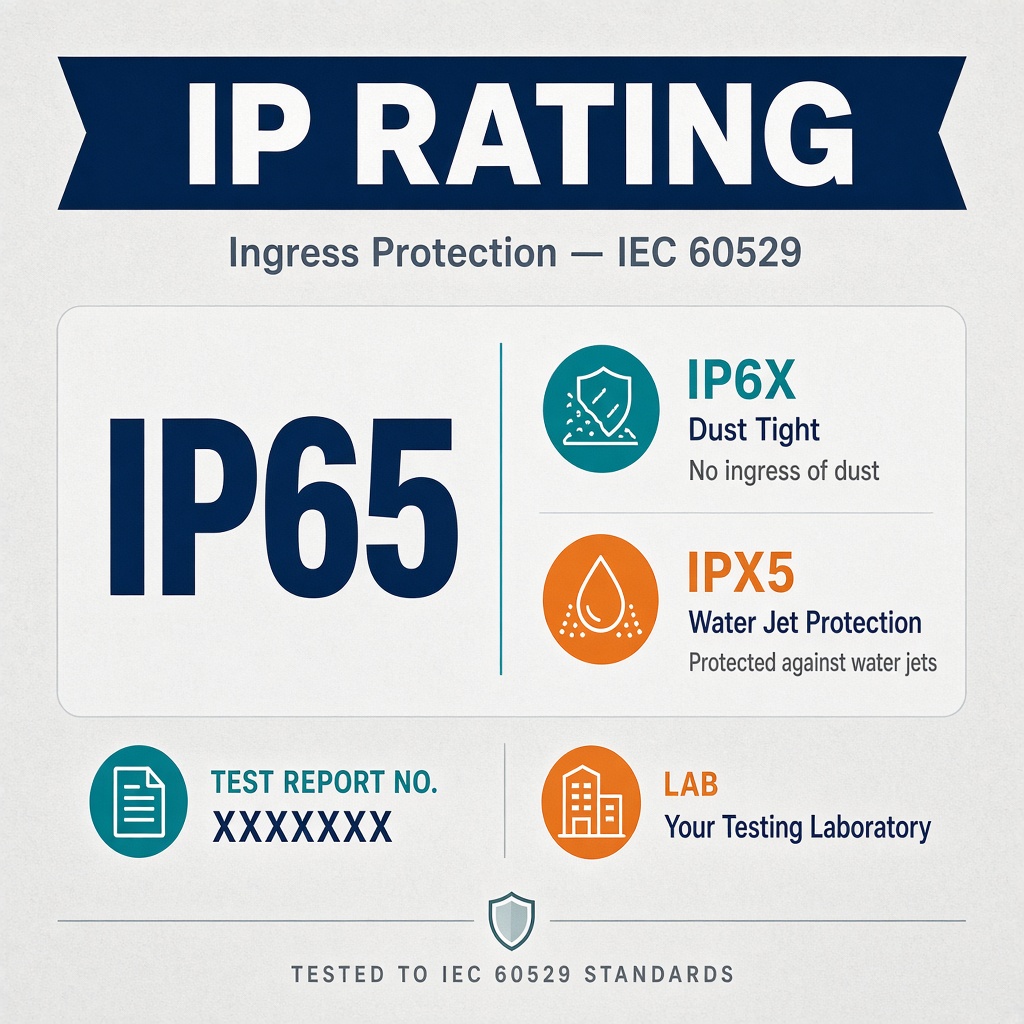
An IP rating (IEC 60529) describes how well an enclosure keeps out dust and water. Nobody issues an “IP certificate” — you buy a lab test report at a defined rating, from a lab that can actually run that method.
Common ratings
Pick the rating your buyer actually needs, then book a lab that can run that exact method — including IP 69K washdown where required.
Dust-tight with water jet protection for outdoor gear
Temporary or continuous immersion — method matters
High-pressure, high-temperature washdown (different setup)
We map the code and book a lab that can run that test
Free tool · no sign-up
Pick the two digits. You'll see what each one means, the test the lab will physically run on your sample, how long it takes and — the part people miss — what the rating does not cover.
Common ratings
Test conditions summarised from IEC 60529. IP 69K for road vehicles sits in ISO 20653. Your product standard may modify or add to these — we confirm which applies before anything is booked.
Check my product's rating →Worth knowing before you pay for anything
An IP rating is not granted by a government department and there is no central register of it. It is a test result. A laboratory runs the tests written in IEC 60529 on your sample, issues a report saying it passed at a stated rating, and you then declare that rating on the product and in your literature.
So the only things that carry any weight are the lab that did the work, the scope it is accredited for, and whether the test conditions in the report match what you are claiming. That is the whole job — and it is where it usually goes wrong, because a report from a lab without the right scope is a report your buyer, your BIS filing or your tender officer can simply refuse.
Four things people get wrong
These four come up on almost every first call.
Immersion and jetting are different physics. A sealed box can sit in a metre of still water for half an hour and still let a pressure jet past a joint. Up to IPX6 the levels build on each other — IPX7 and IPX8 do not. If your product needs both, it is declared as a pair, such as IP66/IP68, and both tests are booked and paid for.
IPX5 means water was tested and solids were not declared. IP6X means the opposite. Writing IPX5 when you meant IP65 quietly drops your dust claim, and buyers who read specs properly will notice. If both digits matter to you, both have to be tested.
IEC 60529 describes what happened under a defined test for a defined time. It is not a promise about hot water, chemicals, steam, pressure changes or years of UV. Advertising a product as waterproof when the report says IPX7 is a claim you cannot support if it is ever questioned.
The 80 °C, 80-bar close-range washdown test is written into ISO 20653 for road vehicles and appears in IEC 60529 as IPX9. They are close but not identical, and a buyer asking for one will not always accept a report written against the other. We confirm which one your customer means before booking.
Where the demand comes from
The reason behind the request usually decides which lab the report has to come from — so it is the first thing we ask.
Several product standards carry an IP requirement inside them — luminaires, control gear, enclosures, charging equipment. Where the filing is BIS, the test report generally has to come from a BIS-recognised laboratory, not merely an accredited one. A perfectly valid NABL report from the wrong lab gets the application returned.
Tender specs name a rating and often name the accreditation too. We read the clause before quoting, because the difference between "IP65" and "IP65 tested at an NABL laboratory with the report in the bidder's own name" is the difference between qualifying and being disqualified on technicals.
Overseas buyers usually want a report they can read in English against IEC 60529 or EN 60529, with the sample clearly identified and photographs of it on the rig. We make sure the report is written so it survives being forwarded to someone who has never heard of the lab.
Platforms increasingly ask for evidence behind a durability claim on the listing. A test report at the exact rating printed on the packaging is what closes that, and it needs to name the model that is actually on sale.
The cheapest time to find out a gasket groove is wrong is before the mould is cut. A short pre-compliance run on a prototype costs a fraction of a failed formal test plus a tooling change, and nothing about it has to be declared.
Product types
Street lights, flood lights, high bays, façade and landscape fittings, downlights and drivers. Typically IP65 or IP66, and often tested alongside the luminaire standard rather than on its own.
Control panels, junction boxes, feeder pillars, meter boxes, distribution boards. The failures here are nearly always the gland plate, the door seal or a vent that was added late.
AC and DC charge points, connectors, battery packs and BMS housings. Usually IP65 upward, and frequently required alongside the electrical safety testing rather than after it.
Handsets, earbuds, wearables, smart home devices, trackers. IP67 and IP68 dominate, and the declared IPX8 depth and duration need deciding before the sample is sent.
Motors, sensors, weighing equipment, conveyors and anything that meets a hose or a steam cleaner. This is where IPX6, IPX9 and IP 69K actually earn their keep.
Junction boxes, inverters, combiner boxes, string monitoring, outdoor CCTV and telecom cabinets. Long UV and weather exposure means the seal choice matters as much as the rating.
How it works
Where the product is mounted, what it meets in service, and who is asking for the rating. Over-rating costs you money on the test and on the tooling; under-rating costs you the sale.
Scope, accreditation, chamber size and rig availability, checked against your rating and your sample's dimensions. Where your filing needs a BIS-recognised lab, that is the constraint we start from.
We look at the seals, glands, vents, fasteners and drain paths before anything ships, and tell you plainly if we think it will fail. Fixing it now is far cheaper than a retest slot.
Samples logged in, tests run to the standard, photographs taken on the rig. We stay on the file through the slot rather than handing you a lab contact and disappearing.
We check the report says what you need it to say, and help you word the rating on the product, the datasheet and the packaging so the claim and the evidence match.
We tell you what let it in and where, usually from the photographs and the ingress pattern. Then we agree the fix and requote the retest honestly — including whether a partial retest is enough or the whole sequence has to run again.
What we need from you
The last one matters more than people expect. A light that sits under an eave and a light that sits on a pole in open rain are not the same test, even if they are the same product.
Send what you have and we'll tell you what is missing. Nothing has to be final to start the conversation.
Why it matters
Printing IP66 on a product is a claim. If the report behind it was run at a lower rating, or on a different variant, or at a lab without that scope, the claim is standing on nothing.
That surfaces at the worst moments — a tender technical evaluation, a customer audit, a warranty dispute over water damage, or a platform asking for evidence behind a listing.
A BIS application returned because the report came from a lab without the right recognition — and the queue restarted.
A tender bid rejected on technicals for a report in the wrong name or against the wrong clause, with no route to appeal it.
A field failure where the product met its rating but the rating was never the right one for where it was installed.
General guidance on IEC 60529 and how test evidence is usually assessed. Requirements vary by product standard, buyer and tender — we confirm yours before booking.
Client feedback
They told us the gland plate would leak before we shipped anything. We changed it, and the IP66 passed first time. The previous round with another consultant cost us two failed attempts.
We needed the report to be acceptable for a BIS filing, not just valid. That distinction was explained to us on the first call and it saved a restart.
Our buyer asked for IP 69K and we'd have booked IPX9 by mistake. They caught it, checked with the buyer, and booked the right one.
Names shortened at our clients' request. References available on request for serious enquiries.
FAQ
Not on its own. There is no standalone law that says every product must carry an IP rating.
What happens instead is that IP requirements sit inside other things — a product standard you are certifying to, a tender specification, a buyer's purchase condition, or a marketplace's evidence policy. So whether it is compulsory for you depends entirely on which of those applies. That is the first thing we establish, because it also decides which lab the report has to come from.
Work backwards from where it lives and what reaches it.
Indoors, dust only, no water — IP5X or IP54 is usually honest. Outdoors in rain, mounted on a pole or wall — IP65 or IP66. Handheld or portable, where being dropped in water is a real risk — IP67. Permanently submerged or buried — IP68, with the depth and duration you declare. Hosed down with hot water — IPX9 or IP 69K.
The commonest error is going higher than the duty needs. Every step up costs money in sealing, in tooling and in test, and buyers rarely pay more for a rating they did not ask for.
The tests themselves are short. Solids probes take under an hour. The dust chamber runs for 8 hours. Most water tests are between 3 and 30 minutes of actual exposure.
What sets the calendar is lab queue and sample logistics, not the test. Plan for one to two weeks in normal conditions once samples reach the lab, longer if you need a rig that is in demand or a chamber big enough for a large enclosure. We tell you the realistic date when we quote, not the optimistic one.
The test report does not expire by itself. What ends its usefulness is a change to the product.
If you change the enclosure, the gasket material, a gland, a vent, a fastener pattern or the moulding tool, the report no longer describes what you are selling and the rating should be retested. Some certification schemes that reference the report also set their own validity periods, which is a separate matter from the report itself.
Yes, and for many products it is the correct way to declare it.
Because IPX7 and IPX8 do not include the jet tests, a product that has to survive both a hose and immersion is declared as a pair — IP66/IP68, for example — with both tests run and both shown on the report. Declaring only IP68 on such a product quietly leaves the hose-down claim unevidenced.
There are two numbers and we always show them separately.
The lab charge, which depends on the rating, the size and weight of your sample and which rigs it needs — a dust chamber run plus IPX9 costs very differently from a single IPX4. And our fee, for the rating assessment, the lab matching, the sample review and managing the file through to the report.
You see the lab's figure before we book, not after. If a retest becomes necessary we requote it honestly rather than treating it as included.
Yes, and for anything with a moulded enclosure we usually suggest it.
A pre-compliance run on a prototype is faster, cheaper and does not have to be declared anywhere. If it fails, you learn where the water gets in while the tool can still be changed. The formal test then follows on production samples.
No, and we would be careful of anyone who says they do both.
Testing is done by accredited laboratories. Our job is to decide the right rating, find the lab with the right scope and rig for your product, prepare the sample and the paperwork so the first attempt is the one that passes, and make sure the report you receive says what your buyer or your filing actually needs it to say.
Send the model, roughly where it gets installed and who is asking for the rating. You'll get a straight answer on what to test for, which laboratory can run it, and what it costs — lab charge and our fee shown separately.

