For export, for shipping, for a buyer who has asked, or to list your product on Amazon, Flipkart and other marketplaces. A full 16-section Safety Data Sheet drafted to the UN GHS rulebook by chemists, in your hands the next day. Complex chemicals and formulations take a little longer, and we'll say so upfront.
Safety Data Sheets
An MSDS (now SDS) is the Safety Data Sheet for a chemical or mixture. Buyers, freight forwarders and customs ask for it so hazards, handling and transport classification are clear — drafted to UN GHS and adapted to the market you sell into.
When you will be asked
You are not buying a government stamp. You are buying a complete Safety Data Sheet your counterparty will accept.
Freight and customs ask before the consignment moves
Domestic and overseas buyers request GHS SDS
Marketplaces and portals need the sheet on file
Adapted to the destination market you sell into
Why people need one
Most people find out they need an MSDS because someone else asks for it. These are the four situations we hear every week.
The buyer, the freight forwarder or the customs broker at the destination asks for it, and the consignment waits until you produce one.
Couriers, airlines and transporters ask for the SDS before they will accept chemical goods. The transport section is what they actually read.
Marketplaces ask for an MSDS before they will list or ship products with chemical content. No sheet, no listing — and often a live listing gets pulled until you supply one.
Industrial and institutional buyers request the SDS to understand what they're handling, how to store it and what to do if it spills. It's often part of vendor onboarding.
Read this before you pay anyone
No government department, lab or authority in India issues an MSDS certificate. A Safety Data Sheet is a document that you, as the manufacturer or supplier, are responsible for — and it has to be accurate, in the right format, and kept current. What a consultant sells you is the work of writing it properly.
We still call it an MSDS certificate on this page, because that's what everyone asks for. But you should know what you're getting, and you should be suspicious of anyone selling you a "3-year validity" on a document that has no expiry date.
What you receive
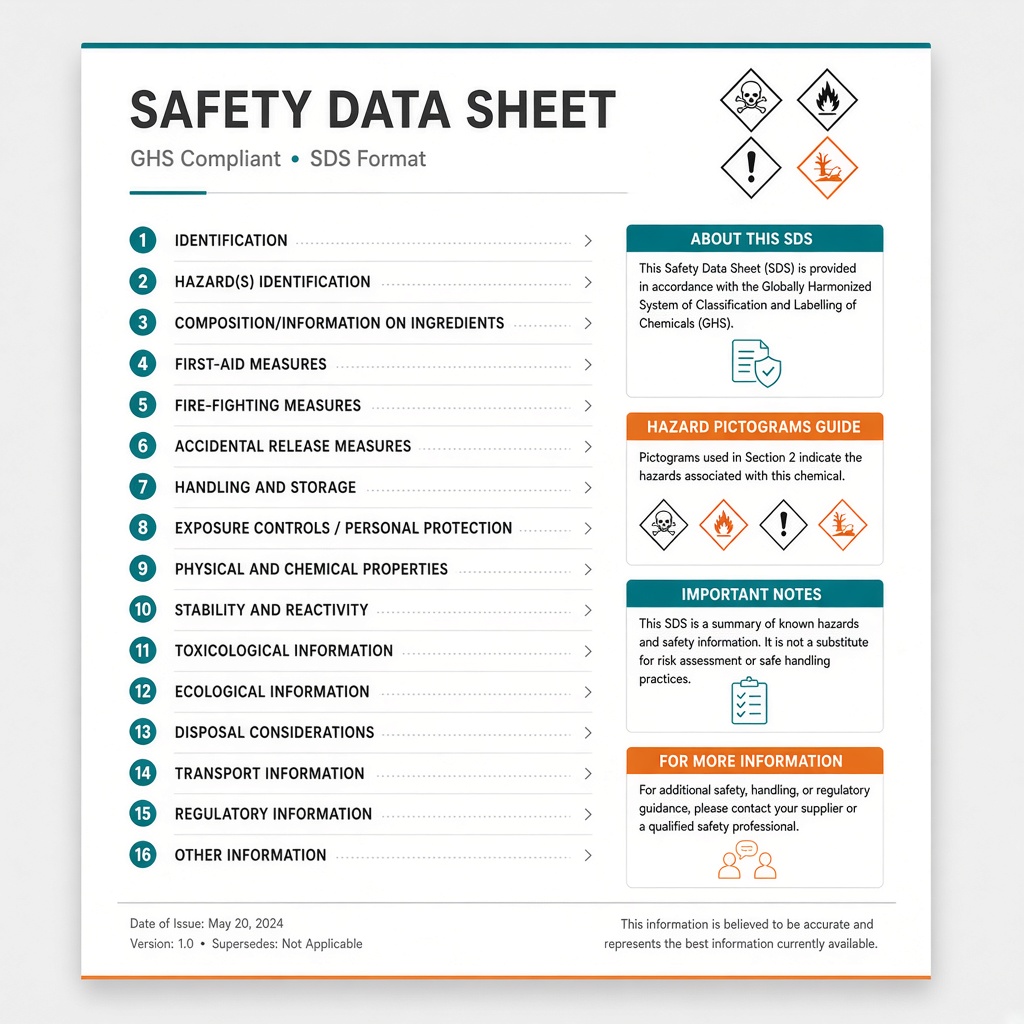
A GHS-compliant Safety Data Sheet has a fixed 16-section structure in a fixed order. Buyers and forwarders check for it. A document missing toxicological or ecological data gets sent back, and that's usually where the cheap ones are thin.
You get it as an editable file and a signed PDF, with the GHS label elements alongside so your packaging team can work from the same document.
Who needs one
If your product is a chemical, or contains one, this is the crowd we work with every week.
Cleaning products, personal care, supplements, aerosols, candles. If it has chemical content, the marketplace will ask for the sheet before it goes live.
Solvents, acids, adhesives, cleaning chemicals, industrial intermediates. One SDS per product, updated whenever the formulation changes.
Creams, serums, perfumes, hair and skin products. Fragrance and preservative content drives the classification, so the formulation detail matters.
Solvent content and flash point decide both the hazard class and the transport section. Getting these wrong is what holds a container.
Lithium cells and packs need an SDS alongside UN 38.3 test summaries before an airline or courier will carry them.
Bringing chemicals in, or moving them for a client, and the supplier's sheet is unusable, out of date or in the wrong language.
The rulebook we work from
Every sheet we write starts from the UN GHS purple book — the rulebook the whole system is built on. From there it's adapted to whichever regime applies at the other end, because GHS is a framework, not a single law. Each region adopts its own version, with its own classification thresholds, required language and regulatory section. A sheet written for India will get questioned in Hamburg or Shanghai.
Annex II of Regulation (EC) No 1907/2006, CLP classification, exposure scenarios where they apply, and the local language of the destination country.
HazCom 2012 alignment with the GHS revision currently adopted, plus US-specific regulatory entries in Section 15.
GB/T standards, Chinese-language sheet and label, and the inventory checks that Chinese importers will ask about.
GSO GHS requirements for UAE, Saudi Arabia and the wider GCC, with Arabic label elements where they're expected.
Written to GHS for domestic supply, transport documentation and the buyers who now ask for it as standard.
Japan, Korea, Taiwan, Brazil, Australia, UK. Tell us the destination on the first call and we'll say plainly whether we've done it before.
If your buyer wants RoHS or REACH compliance alongside the safety data sheet, or a test report to back it up, we handle those too — RoHS and REACH declarations, and testing arranged through ISO/IEC 17025-accredited partner laboratories. Ask once and get the whole list, rather than finding out a fortnight later.
Honest pricing
Most consultants quote you a range and settle the number after they've seen your formulation. Ours starts at ₹2,999 for a single substance, all inclusive.
Mixtures cost more, and so do multiple destination versions — because they are genuinely more work, not because we found something to charge for. You get the full figure before we start, in writing.
How it works
A short call. We confirm whether it's a substance or a mixture, which market it's going to, the price and the turnaround.
Under NDA if you want one. We tell you exactly what's missing rather than guessing and filling gaps with generic text.
Hazard classification from the real composition, then the full 16 sections and the label elements. Usually 24 hours.
You see it before it's final. Editable file plus signed PDF, and one free revision if your buyer comes back with a question.
What we need from you
That's genuinely enough to begin. Everything below helps, but send us the Certificate of Analysis and the ingredient breakdown and we can get moving. Gaps are normal, and part of our job is telling you which ones actually matter.
Client feedback
"Our German buyer rejected the sheet our supplier gave us. Instacertify rewrote it to CLP in two days and the buyer accepted it without a single question."
"They asked for the full formulation and signed an NDA first. Everyone else quoted without even asking what was in the product, which told me something."
"We'd been told our MSDS expires every three years and we had to pay again. They explained it only changes if our formula changes or the rules change in the market we sell to, then updated the one section that needed it."
FAQ
From ₹2,999 plus GST per product for a single substance written for one market, all inclusive. Mixtures take more work and cost more, and so does a separate version for an additional destination country.
You get the full figure in writing before we start. There's no charge for the call where we work out what you actually need.
No. This is the most common piece of misinformation in this market. A Safety Data Sheet has no expiry date and no renewal fee. It isn't a licence issued by anyone, so there is nothing to renew.
It stays valid until something changes. The two things that change it are: your product — a new formulation, a new supplier, a new pack — or the rules in the market you sell into, when the local authority there adopts a new GHS revision or updates its classification requirements.
That's why we ask which countries you ship to. If the rules move in one of your markets, the sheet for that market needs updating. Not on a three-year timer, and not for every market at once.
MSDS is Material Safety Data Sheet. SDS is Safety Data Sheet, the name used under GHS, the globally harmonised system.
They're the same document in practice. The older MSDS had no fixed structure and varied by supplier and country; the modern SDS has the mandatory 16-section format. India and much of Asia still say MSDS out of habit. What we write is a GHS-format SDS — which is what your buyer wants, whatever they call it.
24 hours for a standard product once we have your details — shipping-ready the next day.
Complex chemicals, multi-component formulations and several destination versions take a little longer. We'll tell you how much longer on the first call, rather than after you've paid.
For products with chemical content, usually yes. Marketplaces ask for a Safety Data Sheet before they will list or ship them, and a live listing can be pulled until you supply one. Their warehouses and delivery partners need it for handling and storage too.
Send us the product details and we'll have a sheet ready in 24 hours, in the format the platform will accept.
Two things: the Certificate of Analysis and the ingredient list with percentages. That's enough for us to begin.
Anything else you have helps — supplier SDSs, test reports, flash point and viscosity for liquids, pack sizes. If it's a lithium battery product being prepared for certification, the UN 38.3 test summary goes with it. But don't wait to collect everything before calling; we'll tell you what's genuinely missing.
If your product is a chemical or contains one, almost certainly yes. Your buyer, freight forwarder, airline or the customs authority at the destination will ask for it, and the shipment waits until you produce one.
Even for products that aren't classified as hazardous, buyers frequently ask for a sheet confirming exactly that. We write those too.
Yes, and we'd suggest it. We can't classify a mixture properly without the real composition, so we ask for it, and we understand that your formulation is the business. Send us an NDA or ask for ours before you share anything.
You can. It's your document and there's no rule saying a consultant has to write it. What people find is that hazard classification of a mixture, the transport section and getting the destination country's format right take a lot longer than expected, and a rejected sheet costs more in shipping delays than the sheet cost.
If you have one already and just want it checked, say so. We'll review it and tell you whether it needs a rewrite or a correction.
Sometimes, but check two things. First, is it for the exact product you're shipping, or for one raw material inside it? Second, is your company named in Section 1 as the supplier? If you're putting your name on the product, the sheet needs to be yours.
Yes. Lithium cells and packs need an SDS alongside the UN 38.3 test summary before a courier or airline will accept them. When you're going through certification for a battery product, that summary forms part of the pack.
We prepare the SDS and arrange the testing through ISO/IEC 17025-accredited partner laboratories, so it comes from one place.
Instacertify Labs Private Limited, a certification and compliance consultancy registered in Noida, Uttar Pradesh (CIN U74999UP2022PTC170291), with offices in Noida, Vadodara and Kalyan. We handle SDS and MSDS authoring, BIS, EPR, LMPC, RoHS, REACH, CDSCO, FSSAI, WPC, ISO and CE. We are a private consultancy, not a government body.
One short call and you'll know what your SDS costs, how long it takes, and exactly what we need from you. No obligation, and no charge for the assessment.

