Registration on the SABER platform under the SALEEM programme, the Product Certificate of Conformity for your models, and the Shipment Certificate for every consignment. We work backwards from your sailing date and tell you plainly whether it is achievable.
SABER · SALEEM · Saudi Arabia
SABER is Saudi Arabia’s platform under the SALEEM programme. A PCoC certifies your product models; an SCoC releases each consignment. They are not interchangeable — without a live PCoC, no SCoC, and without an SCoC the goods do not clear.
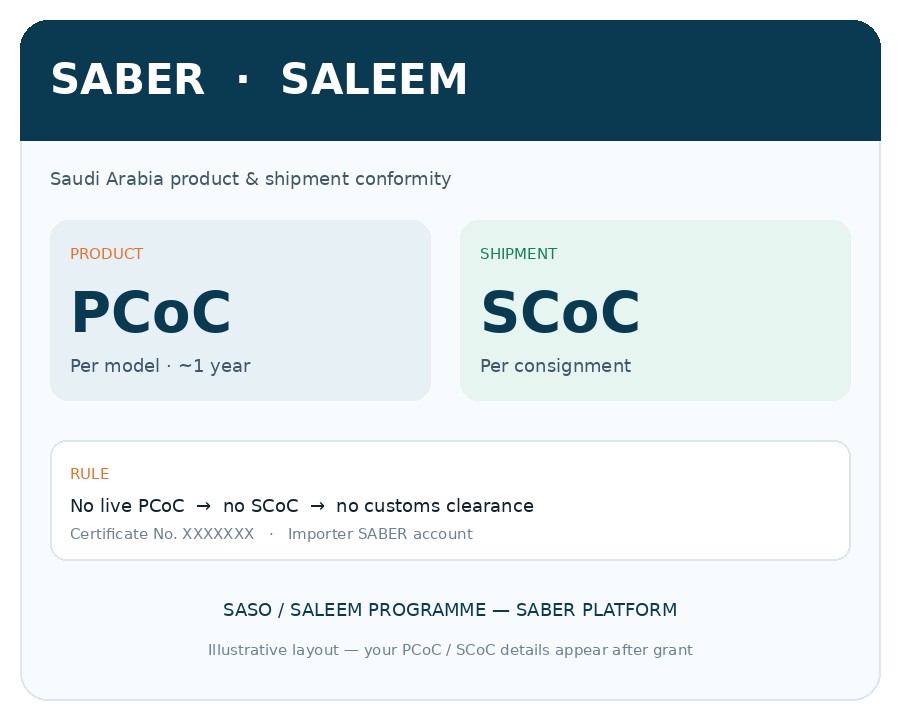
Two certificates
A PCoC certifies the product. An SCoC releases the container. You need both, in that order, on the Saudi importer’s SABER account.
Product Certificate of Conformity — per model, about a year
Shipment Certificate — every consignment, matched to a live PCoC
Confirm HS / category needs SABER before you book testing
Filed on the Saudi importer’s account — we coordinate both sides
The two certificates
These get confused constantly, and the confusion is expensive. One covers your product. The other releases your container. You need both, and they are not interchangeable.
Says your product model meets the Saudi technical regulation that applies to it.
Releases one specific consignment. This is the one customs actually wants to see.
Free tool · no sign-up
Pick your product and where you are in the process. You'll see whether it's regulated, what has to exist before a PCoC can be issued, what the SCoC will need, and the mistake that most often holds up this category.
A guide, not a determination. Regulated status is decided by the HS code as declared, and SASO updates the regulated list periodically — we confirm your product's position in writing before anything is filed.
Check my shipment →The part exporters find out late
SABER is built around the Saudi importer, not the exporter. The account, the product registrations, the certificate requests and the shipment filings all sit under their commercial registration. You supply the test reports and the technical file; they hold the login that turns it into a certificate.
Which means your compliance runs through somebody else's diligence. If your importer registers the wrong HS code, files a model number that does not match your invoice, or lets the PCoC lapse without telling you, your container stops — and you find out when it has already berthed. Working with the importer from the start, rather than assuming they have it handled, is most of the job.
The slow part
The PCoC itself is usually a matter of weeks. What sits underneath it is what moves your sailing date, and it is almost always discovered too late.
Air conditioners, refrigerators, washing machines, water heaters and much lighting need an energy efficiency label, issued through the Saudi Energy Efficiency Center and displayed in Arabic. It has to be in place before the conformity assessment can complete, and missing or incorrect labelling is one of the most reliable ways to get an appliance consignment detained.
Some product categories — including particular steel and construction metal codes — require the Saudi Quality Mark. This is a factory-level scheme involving a plant assessment, not a documentary exercise. Plan it in months, not weeks, and never assume it can be arranged around an existing order.
Reports have to be against the applicable standard, from a recognised laboratory, and for the model you are shipping. A report for a sister model, or one that has aged past what the assessment body accepts, is the commonest reason a PCoC application stalls. If you hold an IECEE CB certificate and report, say so early — it usually covers a great deal of the safety assessment.
Products with a radio need approval from the Saudi communications regulator alongside the SABER route. Two tracks, running in parallel, and the SABER certificate does not substitute for the radio approval. Both have to land before the goods move.
SABER classifies on the code as declared, not on the product description. The code decides whether you are on the PCoC route or the self-declaration route, which technical regulation applies, and whether the certificate you hold will match the customs entry. Settle it before anything else — almost every expensive SABER problem traces back here.
Four things exporters get wrong
It is the halfway point. The PCoC certifies the model; the SCoC releases the container, and it is raised fresh for every consignment against that specific invoice. A year's worth of shipments means a year's worth of SCoCs, and each one is checked against a PCoC that has to still be live on the day.
The certificate names specific models. The invoice names what is actually in the container. When a variant, a revised model code or an extra line item appears on the invoice that is not on the certificate, the SCoC cannot be issued — and this is discovered at the worst possible moment, with the goods already loaded.
Products outside the regulated list do not need a PCoC — but they still need a self-declaration raised in SABER and an SCoC for the shipment. Vague product descriptions and poor images are the usual failure, because SASO has to be able to verify what is being declared.
SASO adds HS codes to the regulated list periodically. In August 2026 paints and pigments, abrasives, steel and construction metals, and tubes and pipes for utility networks came into scope. A category that shipped smoothly a year ago tells you nothing about today — the list has to be checked against the current position each time.
How it works
Confirmed with your Saudi importer, because their declaration is what SABER classifies on. That settles whether you are on the PCoC route or the self-declaration route, and which technical regulation applies.
Energy efficiency label, Quality Mark, radio approval — whichever apply. We find these now, because they are the items that move sailing dates, and we tell you honestly if your date is not achievable.
Gap check against what you already hold — a CB report often covers most of the safety side — then any testing that is genuinely still needed, assembled with the Arabic documentation into a file that passes review first time.
Submitted through SABER against your importer's account, tracked to issue, and checked to confirm it names the exact models and specification you will actually be shipping.
Raised against each commercial invoice, packing list and bill of lading, and reconciled to the PCoC before it goes in. We can run this for every consignment or set your team up to do it — whichever you prefer.
A PCoC runs about a year. We track the expiry and start the renewal before it lapses, so a certificate date never becomes the reason a container is waiting. New models get added to the file rather than discovered on an invoice.
What we need from you
The sailing date matters as much as the product. It tells us whether to plan this properly or to work backwards from a deadline — and whether the deadline is realistic, which we will tell you straight rather than after you have paid.
If a container is already at a port, call rather than emailing. The order in which that gets sorted out decides what it costs.
Why the timing matters
In most markets a documentation error becomes an email. In Saudi Arabia it becomes a container sitting at Jeddah or Dammam while a certificate is arranged retrospectively — and no amount of urgency shortens the process.
That is why almost all the value in this work is in the sequencing, done early. The certificate itself is the straightforward part.
A consignment held because no SCoC could be raised — demurrage and storage running from the day it berths.
An expired PCoC found at the shipment stage, with the renewal taking longer than the goods can afford to wait.
A mismatch between invoice and certificate on one line item, which stops the whole consignment and not just that line.
A missing energy label on an appliance shipment — a prerequisite that cannot be obtained while the goods are at the port.
General guidance on Saudi conformity practice. Requirements, fees and the regulated product list are set by SASO and change periodically; timings depend on the certification body and the product. We confirm your position before anything is filed.
Client feedback
We had a PCoC and thought we were done. They explained the SCoC was needed for every container, not once, and set it up before our first shipment sailed.
The energy label was the thing nobody had mentioned. Finding out at the quoting stage rather than at Jeddah saved us a month and a lot of storage.
They caught that our invoice had two model codes that weren't on the certificate. That one check stopped the container from being held.
Names shortened at our clients' request. References available on request for serious enquiries.
FAQ
They do different jobs and you need both.
The PCoC — Product Certificate of Conformity — certifies that a product model meets the applicable Saudi technical regulation. It is issued per model, based on test reports and a technical file, and runs for about a year.
The SCoC — Shipment Certificate of Conformity — releases one specific consignment. It is raised against that shipment's commercial invoice and checked against a live PCoC for every regulated item on board. It is valid for that shipment only, so every container needs a new one.
Put simply: the PCoC is about the product, the SCoC is about the container, and customs wants the SCoC.
Not for a regulated product. The SCoC is issued only after the certification body verifies that a valid PCoC exists covering the items on the invoice.
For products outside the regulated list it works differently: no PCoC is needed, but a self-declaration has to be raised in SABER in its place, and the SCoC is still required. Non-regulated means a lighter route, not no route.
The importer. SABER is built around the Saudi importer's commercial registration, and the account, product registrations and certificate requests all sit with them.
You supply the test reports, the technical file, the model details and the photographs. They hold the login that turns it into a certificate. This is why we work with both sides — the commonest failure is each party assuming the other has it in hand.
Where the test reports already exist and the product is straightforward, plan for a few weeks.
What actually sets the calendar is whatever sits underneath it. An energy efficiency label for an appliance adds weeks. A Saudi Quality Mark for steel or certain building materials involves a factory assessment and is measured in months. Testing, if it is needed from scratch, adds a lab queue on top.
Tell us your sailing date on the first call and we will work backwards from it and say plainly whether it holds.
Around a year, and it is issued per model per factory.
The renewal matters more than people expect, because an SCoC cannot be raised against an expired PCoC. A certificate quietly lapsing between shipments is a common way to end up with a container waiting at a port for something that should have been routine. We track expiry dates and start renewals before they bite.
Yes. Everything imported is registered through SABER.
Non-regulated products take the self-declaration route — the importer or manufacturer declares conformity electronically in the platform — and then an SCoC is still raised for the shipment. No conformity assessment body and no testing, so it is faster and cheaper, but it is not nothing.
The usual failures here are vague product descriptions and poor images, because SASO has to be able to verify what is being declared.
Often considerably, particularly for electrical products.
An IECEE CB certificate and report covers a great deal of the safety assessment, and if you have done CE marking you will usually have much of the technical file already — bill of materials, critical component list, drawings, risk assessment.
Send whatever you hold with your first enquiry. It is the quickest way to reduce both the timeline and the quote.
Call rather than email — the sequence matters and charges are already running.
The first question is whether a PCoC exists and is still valid for the exact models and HS code on the customs declaration. If it does and it matches, the SCoC is usually the quicker part and can move today. If it does not exist, the certificate has to be built from the beginning, and that cannot be accelerated by paying more.
We will tell you honestly what the realistic timeline is rather than what you would like to hear, because your storage decisions depend on knowing it.
Send the HS code, the model numbers and when the goods need to move. You'll get a straight answer on whether it's regulated, what has to happen before a PCoC can be issued, what the SCoC will need — and whether your date is achievable.

